


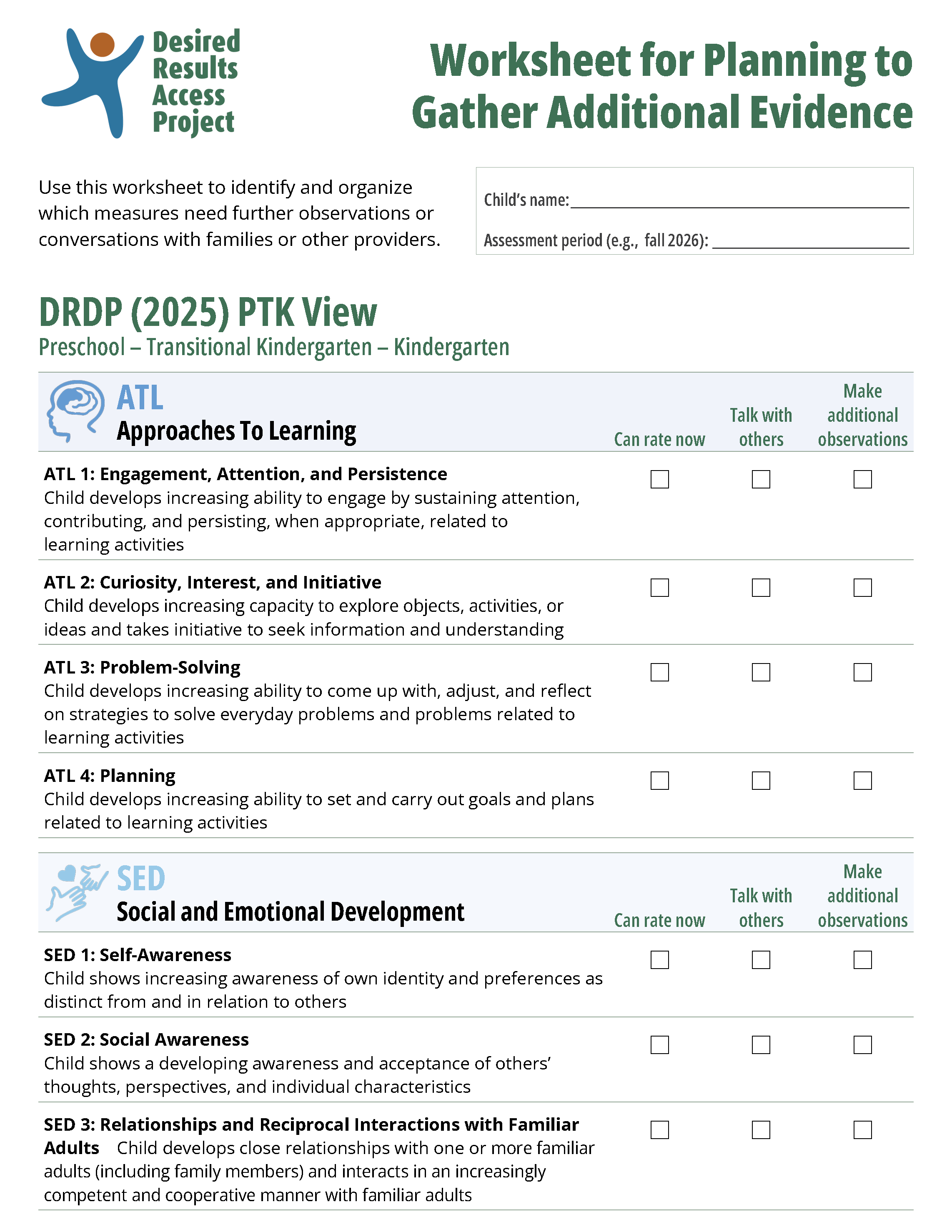
Download the PDF worksheet above and use to identify and organize which measures need further observations or conversations with families or other providers.
DRDP (2025) PTK View
Child’s name: ______________________________
Assessment period (e.g., fall 2026): ______________________________
For each measure, consider whether you:
- Can rate now
- Need to talk with others
- Need to make additional observations
Approaches to Learning (ATL)
ATL 1: Engagement, Attention, and Persistence
Child develops increasing ability to engage by sustaining attention, contributing, and persisting, when appropriate, related to learning activities.
ATL 2: Curiosity, Interest, and Initiative
Child develops increasing capacity to explore objects, activities, or ideas and takes initiative to seek information and understanding.
ATL 3: Problem-Solving
Child develops increasing ability to come up with, adjust, and reflect on strategies to solve everyday problems and problems related to learning activities.
ATL 4: Planning
Child develops increasing ability to set and carry out goals and plans related to learning activities.
Social and Emotional Development (SED)
SED 1: Self-Awareness
Child shows increasing awareness of own identity and preferences as distinct from and in relation to others.
SED 2: Social Awareness
Child shows a developing awareness and acceptance of others’ thoughts, perspectives, and individual characteristics.
SED 3: Relationships and Reciprocal Interactions with Familiar Adults
Child develops close relationships with one or more familiar adults (including family members) and interacts in an increasingly competent and cooperative manner with familiar adults.
SED 4: Relationships and Interactions with Peers
Child develops and maintains close relationships with one or more peers and becomes increasingly competent and cooperative in peer interactions.
SED 5: Emotional Knowledge and Regulation
Child develops an increasing ability to identify and process emotions.
Foundational Language Development (FLD)
FLD 1: Understanding Language (Receptive)
Child understands increasingly complex language, including vocabulary in home language, English, sign language, or Augmentative and Alternative Communication (AAC).
FLD 2: Using Language (Expressive)
Child uses increasingly complex language, including vocabulary, sentences, questions, narratives, and explanations, in their home language, English, sign language, or Augmentative and Alternative Communication (AAC).
FLD 3: Shared Communication and Conversation
Child engages in back-and-forth communication with shared focus in increasingly extended conversations, using home language, English, sign language, or augmentative and alternative communication (AAC).
FLD 4: Foundational Literacy Skills
Child shows increasing ability to manipulate and combine components of language related to early literacy:
- phonological awareness for children learning to communicate using spoken language;
- location, handshapes, and movement for children learning to communicate using sign language; and
- recognition, combination, and use in set phrases for children learning to communicate using Augmentative and Alternative Communication (AAC) symbols.
FLD 5: Alphabetics and Print Knowledge
Child shows increasing awareness of symbols, characters, or letters in the environment, including identifying how letter and word names, sounds, or fingerspelling correspond to printed text or braille.
FLD 6: Writing
Child shows increasing ability to write using marks, scribbles, drawings, letters, characters, or words to represent meaning.
English Language Development (ELD)
ELD 1: Comprehension of English (Receptive English)
Child shows increasing progress toward fluency in understanding spoken English.
ELD 2: Self-Expression in English (Expressive English)
Child shows increasing progress toward fluency in using spoken English to communicate.
ELD 3: Understanding and Responding to English Literacy Activities
Child shows increasing progress in comprehending literacy activities presented in spoken English (e.g., books, stories, songs, and poems).
ELD measures are completed only for preschool-age children whose home language is other than English and whose family has identified spoken English as a method or mode of communication for their child.
Math (MATH)
MATH 1: Spatial Thinking
Child shows increasing understanding of objects in relation to each other and how objects move in space.
MATH 2: Classification
Child shows increasing ability to sort objects into groups according to attributes, qualities, features, characteristics, or use.
MATH 3: Number and Counting
Child shows developing understanding of number and quantity.
MATH 4: Number Operations
Child shows increasing ability to add and subtract small quantities of objects.
MATH 5: Measurement
Child shows increasing understanding of measurable properties such as size, length, weight, and capacity (volume), and how to quantify those properties.
Science (SCI)
SCI 1: Cause and Effect
Child develops increasing ability to observe, anticipate, and reason about the cause-and-effect relationships between actions and events.
SCI 2: Inquiry Through Observation and Investigation
Child develops increasing ability to carry out observations, explorations, and investigations in the environment.
SCI 3: Documentation and Communication of Inquiry
Child develops increasing capacity to describe, record, and communicate about their observations and investigations.
Physical Development (PD)
PD 1: Perceptual-Motor Skills and Movement Concepts
Child moves body and interacts with the environment, demonstrating increasing body awareness, spatial awareness, and directional awareness.
PD 2: Gross Locomotor Movement Skills
Child shows increasing proficiency in fundamental locomotor skills (e.g., rolling, crawling, cruising, walking, running, jumping, galloping).
PD 3: Gross Motor Manipulative Skills
Child shows increasing proficiency in gross motor manipulative skills (e.g., reaching, kicking, throwing, and catching).
PD 4: Fine Motor Manipulative Skills
Child demonstrates increasing precision, strength, coordination, and efficiency when using muscles of the hand for play and functional tasks.
Health (HLTH)
HLTH 1: Safety
Child shows increasing awareness of safety and increasingly demonstrates knowledge of safety skills.
HLTH 2: Understanding of Health and Wellness
Child shows increasing knowledge of health and the ability to respond effectively to internal cues from their body to support wellness.
HLTH 3: Personal Care Routines: Hygiene
Child increasingly responds to and initiates personal care routines that support hygiene.
HLTH 4: Personal Care Routines: Feeding
Child responds to feeding and feeds self with increasing proficiency.
HLTH 5: Personal Care Routines: Self-Dressing
Child develops and refines ability to participate in and take responsibility for dressing self.