


An Early Childhood Developmental Continuum
For use with children with Individualized Education Programs (IEPs)
Child and Assessment Information
- Child’s name (first and last)
- Statewide Student Identifier (10-digit SSID)
- Assessment period (e.g., fall 2026)
- Date DRDP was completed (month/day/year; e.g., 09/08/2026)
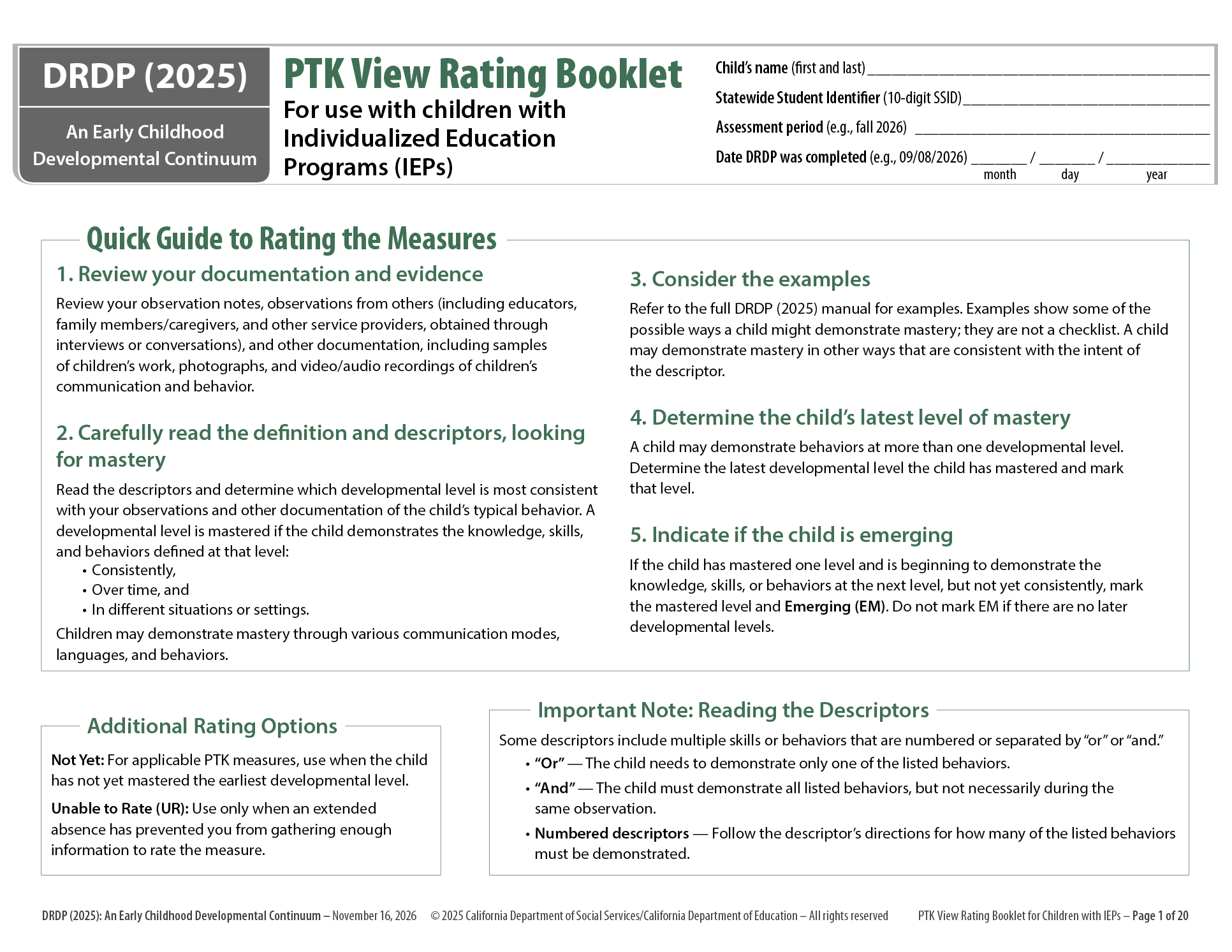
Quick Guide to Rating the Measures
Review your documentation and evidence
Review your observation notes, observations from others (including educators, family members/caregivers, and other service providers, obtained through interviews or conversations), and other documentation, including samples of children’s work, photographs, and video/audio recordings of children’s communication and behavior.
Carefully read the definition and descriptors, looking for mastery
Read the descriptors and determine which developmental level is most consistent with your observations and other documentation of the child’s typical behavior. A developmental level is mastered if the child demonstrates the knowledge, skills, and behaviors defined at that level:
- Consistently,
- Over time, and
- In different situations or settings.
Children may demonstrate mastery through various communication modes, languages, and behaviors.
Consider the examples
Refer to the full DRDP (2025) manual for examples. Examples show some of the possible ways a child might demonstrate mastery; they are not a checklist. A child may demonstrate mastery in other ways that are consistent with the intent of the descriptor.
Determine the child’s latest level of mastery
A child may demonstrate behaviors at more than one developmental level. Determine the latest developmental level the child has mastered and mark that level.
Indicate if the child is emerging
If the child has mastered one level and is beginning to demonstrate the knowledge, skills, or behaviors at the next level, but not yet consistently, mark the mastered level and Emerging (EM). Do not mark EM if there are no later developmental levels.
Additional Rating Options
Not Yet: For applicable PTK measures, use when the child has not yet mastered the earliest developmental level.
Unable to Rate (UR): Use only when an extended absence has prevented you from gathering enough information to rate the measure.
Important Note: Reading the Descriptors
Some descriptors include multiple skills or behaviors that are numbered or separated by “or” or “and.”
- “Or” — The child needs to demonstrate only one of the listed behaviors.
- “And” — The child must demonstrate all listed behaviors, but not necessarily during the same observation.
- Numbered descriptors — Follow the descriptor’s directions for how many of the listed behaviors must be demonstrated.
ATL — Approaches To Learning
ATL 1: Engagement, Attention, and Persistence
Child develops increasing ability to engage by sustaining attention, contributing, and persisting, when appropriate, related to learning activities
Additional rating options: Emerging (EM); Unable to Rate (UR).
| Developmental level | Descriptor |
|---|---|
| Responding Earlier | Orients to people, objects, or changes in the environment |
| Responding Later | Engages in explorations of people or objects for brief periods |
| Exploring Earlier | Engages in simple self-initiated activities, sometimes with adult support |
| Exploring Later | Engages in and returns to self-initiated activities after a brief interruption |
| Building Earlier | Engages in self-initiated activities for extended periods of time |
| Building Middle | Engages in group learning activities with adult guidance |
| Building Later | Manages distractions or challenges with adult support during group learning activities |
| Integrating Earlier | Manages distractions or challenges on own during group learning activities |
| Integrating Middle | Engages in complex adult-selected group learning activities with multiple components |
| Integrating Later | Engages in, with adult support, structured learning and returns to complex adult-selected activities that span several time periods (e.g., morning to afternoon or one day to the next) |
ATL 2: Curiosity, Interest, and Initiative
Child develops increasing capacity to explore objects, activities, or ideas and takes initiative to seek information and understanding
Additional rating options: Emerging (EM); Unable to Rate (UR).
| Developmental level | Descriptor |
|---|---|
| Responding Earlier | Orients toward movement or changes in people, objects, or sounds |
| Responding Later | Shows interest in new or unexpected characteristics or actions of people or objects |
| Exploring Earlier | Explores objects and notices and responds to interactions with people |
| Exploring Later | Explores new ways to use familiar objects outside of their intended use |
| Building Earlier | Explores self-selected ideas, objects, or events by manipulating, or asking simple “what” or “where” questions |
| Building Middle | Explores self-selected ideas, objects, or events by examining, manipulating, or asking detailed “why” or “how” questions, often with adult prompting |
| Building Later | Explores self-selected ideas, objects, or events in greater depth, over repeated occasions, sometimes with adult support |
| Integrating Earlier | Tries out and builds on new ideas or approaches introduced by adults to extend explorations |
| Integrating Middle | Tests how things or materials react under different conditions by modifying actions or approaches |
| Integrating Later | Seeks purposefully to understand new information by making connections to information they know well |
ATL 3: Problem-Solving
Child develops increasing ability to come up with, adjust, and reflect on strategies to solve everyday problems and problems related to learning activities
Additional rating options: Emerging (EM); Unable to Rate (UR).
| Developmental level | Descriptor |
|---|---|
| Responding Earlier | Orients toward people, sounds, or objects |
| Responding Later | Explores doing things with people or objects and attends to what happens |
| Exploring Earlier | Tries different ways to do things using people or objects when encountering problems |
| Exploring Later | Uses effective strategies, suggested by others or observed, to solve problems |
| Building Earlier | Comes up with strategies to solve everyday problems, with adult support |
| Building Middle | Identifies different aspects of everyday problems and comes up with strategies to try to solve them |
| Building Later | Pauses and examines everyday problems before trying out one or more targeted strategies to solve them |
| Integrating Earlier | Examines novel or complex problems and seeks help to come up with strategies to solve them |
| Integrating Middle | Uses strategies to solve the first part of novel or complex problems, then examines the next part of problems, and shifts strategy to solve them, sometimes with adult support |
| Integrating Later | Uses a variety of strategies to solve novel or complex problems on own |
ATL 4: Planning
Child develops increasing ability to set and carry out goals and plans related to learning activities
Additional rating options: Not yet; Emerging (EM); Unable to Rate (UR).
| Developmental level | Descriptor |
|---|---|
| Responding Earlier | Not applicable (N/A). There are no earlier levels for this measure. |
| Responding Later | Not applicable (N/A). There are no earlier levels for this measure. |
| Exploring Earlier | Not applicable (N/A). There are no earlier levels for this measure. |
| Exploring Later | Participates in familiar routines and activities |
| Building Earlier | Carries out the next two steps of familiar learning activities |
| Building Middle | Carries out the next one or two steps of new learning activities |
| Building Later | Makes and carries out a one-or two-step plan for familiar learning activities, using adult-prompted strategies (e.g., checklist, visual reminder) |
| Integrating Earlier | Makes and carries out a one- or two-step plan using familiar strategies for new learning activities, sometimes with adult support |
| Integrating Middle | Makes and carries out a multi-step plan for new learning activities on own or with peers |
| Integrating Later | Extends a multi-step plan beyond the initial goal on own or with peers |
SED — Social and Emotional Development
SED 1: Self-Awareness
Child shows increasing awareness of own identity and preferences as distinct from and in relation to others
Additional rating options: Emerging (EM); Unable to Rate (UR).
| Developmental level | Descriptor |
|---|---|
| Responding Earlier | Responds to others |
| Responding Later | Uses senses and movement to explore self and others |
| Exploring Earlier | Responds to their own name or nickname |
| Exploring Later | Communicates own needs and wants |
| Building Earlier | Expresses simple ideas about self and connection to others |
| Building Middle | Describes self, based on aspects of their physical appearance related to specific identities (e.g., race, ethnicity, gender, height, clothing) |
| Building Later | Describes several of own preferences |
| Integrating Earlier | Compares own preferences, feelings, or cultural practices to those of others |
| Integrating Middle | Describes self, based on perceived personal qualities related to specific situations or contexts (e.g., “I’m shy at school”) |
| Integrating Later | Identifies strengths and weaknesses by comparing self with others |
SED 2: Social Awareness
Child shows a developing awareness and acceptance of others’ thoughts, perspectives, and individual characteristics
Additional rating options: Emerging (EM); Unable to Rate (UR).
| Developmental level | Descriptor |
|---|---|
| Responding Earlier | Responds to faces, voices, or actions of other people |
| Responding Later | Anticipates what familiar people will do in repeated experiences such as care routines |
| Exploring Earlier | Shares a common focus with another person |
| Exploring Later | Acts in response to what they think another person wants |
| Building Earlier | Communicates about others’ feelings, behaviors, or preferences |
| Building Middle | Communicates that others’ behaviors are related to their thoughts or feelings |
| Building Later | Communicates that others’ behaviors are related to their consistent preferences or past experiences |
| Integrating Earlier | Acknowledges that the thoughts or feelings of others can be different from child’s own |
| Integrating Middle | Demonstrates understanding that others’ nonverbal cues (e.g., body language, tone of voice) communicate how they feel |
| Integrating Later | Celebrates others’ success and offers peers solutions to problems, sometimes with adult encouragement |
SED 3: Relationships and Reciprocal Interactions with Familiar Adults
Child develops close relationships with one or more familiar adults (including family members) and interacts in an increasingly competent and cooperative manner with familiar adults
Additional rating options: Emerging (EM); Unable to Rate (UR).
| Developmental level | Descriptor |
|---|---|
| Responding Earlier | Responds to faces, voices, or actions of people nearby |
| Responding Later | Shows interest in familiar adults |
| Exploring Earlier | Shows a preference for interacting with familiar adults over unfamiliar adults |
| Exploring Later | Participates in familiar routines and activities with familiar adults |
| Building Earlier | Interacts for extended periods with familiar adults in a variety of situations |
| Building Middle | Engages with familiar adults in ways that indicate an emerging understanding of the adult’s feelings or preferences |
| Building Later | Engages in back-and-forth interactions with a familiar adult to agree on activities they may want to do together in the short term |
| Integrating Earlier | Works cooperatively with familiar adults, over sustained periods, to plan and carry out mutually enjoyable activities |
| Integrating Middle | Acknowledges or accepts the communicated interests, preferences, or goals of familiar adults even when different from own |
| Integrating Later | Initiates cooperative interactions that follow the intentions or goals of familiar adults even when in conflict with own |
SED 4: Relationships and Interactions with Peers
Child develops and maintains close relationships with one or more peers and becomes increasingly competent and cooperative in peer interactions
Additional rating options: Emerging (EM); Unable to Rate (UR).
| Developmental level | Descriptor |
|---|---|
| Responding Earlier | Shows awareness of other people, including children |
| Responding Later | Shows interest in nearby children |
| Exploring Earlier | Indicates interest in being near peers and orients own activity to a peer’s activity |
| Exploring Later | Engages with peers in brief back-and-forth of objects, actions, or words |
| Building Earlier | Plays together with various peers for brief amounts of time, when initiated or supported by an adult |
| Building Middle | Initiates or joins cooperative play with peers or preferred peers |
| Building Later | Maintains cooperative play with peers or preferred peers for extended amounts of time |
| Integrating Earlier | Co-creates games or tasks with peers that involve clear, simple rules (e.g., turn-taking) and roles |
| Integrating Middle | Chooses preferred peers or peers to play or work with and compromises with them to achieve goals |
| Integrating Later | Works with preferred peers or peers to achieve shared goals, including using concepts of fairness or justice to resolve conflict with them |
SED 5: Emotional Knowledge and Regulation
Child develops an increasing ability to identify and process emotions
Additional rating options: Emerging (EM); Unable to Rate (UR).
| Developmental level | Descriptor |
|---|---|
| Responding Earlier | Calms in response to care from a familiar adult |
| Responding Later | Orients to a familiar adult when distressed and responds when comforted by them |
| Exploring Earlier | Shows preference for certain familiar adults for comfort and care |
| Exploring Later | Comforts self or seeks comfort from familiar adults |
| Building Earlier | Seeks out familiar adults for support when experiencing an emotion |
| Building Middle | Recognizes basic emotions (e.g., happy, mad) in self |
| Building Later | Makes connections for reasons behind basic emotions, sometimes with adult support |
| Integrating Earlier | Uses a few strategies to process their emotions, sometimes with adult support |
| Integrating Middle | Makes connections between some of their emotional experiences and sensory experiences |
| Integrating Later | Uses numerous or varied strategies to process their emotions in different situations |
FLD — Foundational Language Development
FLD 1: Understanding Language (Receptive)
Child understands increasingly complex language, including vocabulary in home language, English, sign language, or Augmentative and Alternative Communication (AAC)
Additional rating options: Emerging (EM); Unable to Rate (UR).
| Developmental level | Descriptor |
|---|---|
| Responding Earlier | Responds to sounds or sights nearby in the environment |
| Responding Later | Orients toward the source of sounds or tracks sights in the environment, including familiar voices or faces |
| Exploring Earlier | Shows understanding that communication with gestures, words, or signs carries meaning |
| Exploring Middle | Shows understanding of a variety of single words in their environment |
| Exploring Later | Shows understanding of frequently used simple phrases or sentences, in the present |
| Building Earlier | Shows understanding of phrases or sentences, including those referring to the past or future |
| Building Middle | Shows understanding of vocabulary that describes attributes and comparisons in context (e.g., in conversations, stories, or learning activities) |
| Building Later | Shows understanding of language, which refers to abstract concepts, including imaginary events |
| Integrating Earlier | Shows understanding of a variety of statements that explain how or why things happen |
| Integrating Middle | Shows understanding of a variety of statements that explain how, why, or the order in which things happen |
| Integrating Later | Shows understanding of a variety of verbs that differ in manner (e.g., “look,” “peek,” “glare”) and adjectives that differ in intensity (e.g., “large,” “gigantic”) |
FLD 2: Using Language (Expressive)
Child uses increasingly complex language, including vocabulary, sentences, questions, narratives, and explanations, in their home language, English, sign language, or Augmentative and Alternative Communication (AAC)
Additional rating options: Emerging (EM); Unable to Rate (UR).
| Developmental level | Descriptor |
|---|---|
| Responding Earlier | Makes sounds or moves hands spontaneously |
| Responding Later | Makes sounds, gestures, or facial expressions with intention |
| Exploring Earlier | Uses vocal sounds with multiple syllables or hand movements in language-like sequences with the intention to communicate |
| Exploring Middle | Uses a growing variety of single words, word approximations, signs, words and signs together, conventional gestures, or symbols to communicate |
| Exploring Later | Combines two words, signs, a word and a sign, or symbols to communicate simple ideas |
| Building Earlier | Uses phrases and sentences of more than two words, signs, words and signs together, or symbols, including a variety of nouns, verbs, or pronouns to communicate |
| Building Middle | Uses phrases and sentences that contain nouns, verbs, and their modifiers (e.g., adjectives, adverbs) |
| Building Later | Uses complete sentences that communicate ideas or simple stories using common connecting words, signs, words and signs, or symbols |
| Integrating Earlier | Uses complex sentences to describe the relationships between people, objects, or events using words, signs, words and signs together, or symbols |
| Integrating Middle | Combines sentences to communicate complex ideas, providing additional detail about relationships between people, objects, or events using words, signs, words and signs together, or symbols |
| Integrating Later | Uses most of the grammar of adult-like language, using words, signs, words and signs together, or symbols |
FLD 3: Shared Communication and Conversation
Child engages in back-and-forth communication with shared focus in increasingly extended conversations, using home language, English, sign language, or Augmentative and Alternative Communication (AAC)
Additional rating options: Emerging (EM); Unable to Rate (UR).
| Developmental level | Descriptor |
|---|---|
| Responding Earlier | Responds to others |
| Responding Later | Pays attention when an adult communicates to them |
| Exploring Earlier | Imitates adult speech sounds or signs and engages in turn-taking through vocalization, gestures, or eye gaze |
| Exploring Middle | Uses single gestures, words, or signs to take turns in brief back-and-forth communication with adults, including responding to simple questions |
| Exploring Later | Uses combinations of words, gestures, and signs to take turns in brief back-and-forth communication |
| Building Earlier | Engages in brief conversations on topic for several turns, sharing opinions and thoughts |
| Building Middle | Engages in conversations, building on the other person’s ideas |
| Building Later | Adjusts responses to meet the needs of the other person during conversations (e.g., providing clarifying comments), spoken or signed |
| Integrating Earlier | Expands on ideas of others during conversations by adding detail, making predictions, or offering possible solutions |
| Integrating Middle | Seeks additional information during extended conversations to understand and build on the ideas and perspectives of others |
| Integrating Later | Displays appropriate turn-taking and social conventions of conversation |
FLD 4: Foundational Literacy Skills
Child shows increasing ability to manipulate and combine components of language related to early literacy:
- phonological awareness for children learning to communicate using spoken language;
- location, handshapes, and movement for children learning to communicate using sign language; and
- recognition, combination, and use in set phrases for children learning to communicate using Augmentative and Alternative Communication (AAC) symbols
Additional rating options: Not yet; Emerging (EM); Unable to Rate (UR).
Communication Modality
Descriptors for children who are learning to communicate using a spoken language
or
Descriptors for children who are learning to communicate using sign language
or
Descriptors for children who are learning to communicate using AAC symbols
| Developmental level | Descriptor |
|---|---|
| Responding Earlier | Not applicable (N/A). There are no earlier levels for this measure. |
| Responding Later | Not applicable (N/A). There are no earlier levels for this measure. |
| Exploring Earlier | Not applicable (N/A). There are no earlier levels for this measure. |
| Exploring Middle | Spoken language: Demonstrates awareness of variations in sounds or Sign language: Attends, when prompted, to hands or a person who is signing or AAC symbols: Participates in cause and effect play |
| Exploring Later | Spoken language: Engages in play with syllables or sounds in words or rhymes or Sign language: Produces familiar fingerspelled words as signs or AAC symbols: Explores devices or symbols |
| Building Earlier | Spoken language: Engages in familiar rhymes or songs or Sign language: Plays with how signs are produced or AAC symbols: Points to familiar symbols following modeling from an adult |
| Building Middle | Spoken language: Demonstrates understanding of the syllables in words with two or more syllables or Sign language: Recognizes the phonological features of signs (e.g., handshape, location, and movement) or AAC symbols: Points to a few core words that are introduced and reinforced by an adult |
| Building Later | Spoken language: Isolates and pronounces the first sound of a word, with support of pictures or objects or Sign language: Produces signs that have specific phonological features of signs or AAC symbols: Isolates the first sound of a spoken word, with support of pictures or objects |
| Integrating Earlier | Spoken language: Blends onset and rimes into words in speech, with adult support or Sign language: Segments signs to modify the meaning or AAC symbols: Demonstrates understanding of how language is organized on AAC device to access non-core words |
| Integrating Middle | Spoken language: Segments onset and rime of single-syllable spoken words in English, or segments each syllable of two-syllable words in Spanish or Sign language: Segments a sentence into isolated signs or AAC symbols: Segments a sentence composed of AAC symbols or print into its core units of meaning |
| Integrating Later | Spoken language: Segments spoken single-syllable words into their complete sequence of individual sounds, or segments each syllable of three-syllable words in Spanish or Sign language: Demonstrates understanding that the same idea can be communicated in different ways or AAC symbols: Segments spoken single-syllable words into their complete sequence of individual sounds |
FLD 5: Alphabetics and Print Knowledge*
Child shows increasing awareness of symbols, characters, or letters in the environment, including identifying how letter and word names, sounds, or fingerspelling correspond to printed text or braille
*Dual language learners may demonstrate differences in how they approach letter and word knowledge, given that some languages use letters (e.g., English, Spanish, Tagalog, Arabic, Hebrew), while others use characters (e.g., Chinese).
Additional rating options: Not yet; Emerging (EM); Unable to Rate (UR).
| Developmental level | Descriptor |
|---|---|
| Responding Earlier | Not applicable (N/A). There are no earlier levels for this measure. |
| Responding Later | Not applicable (N/A). There are no earlier levels for this measure. |
| Exploring Earlier | Not applicable (N/A). There are no earlier levels for this measure. |
| Exploring Middle | Follows along briefly when an adult names pictures or objects in a book |
| Exploring Later | Demonstrates awareness that pictures or objects can represent people or things |
| Building Earlier | Distinguishes letters, signs, or characters (e.g., 山 with a picture of a mountain next to it) from other symbols or pictures |
| Building Middle | Identifies some (3-10) letters by name in an alphabetic language or Identifies some characters (e.g., 山; 火) by meaning |
| Building Later | Identifies about half of letters (11-15) by name in an alphabetic language and Identifies own name in print |
| Integrating Earlier | Identifies the corresponding sounds or handshapes of about half of the letters in an alphabetic language and Identifies a few familiar printed words |
| Integrating Middle | For all children: Identifies the sounds or handshapes of all letters in an alphabetic language and demonstrates one of the following: For children who use a spoken language: Decodes regularly spelled one-syllable words in English or two-syllable words in Spanish or For children who do not use a spoken language: Identifies a growing variety of printed words |
| Integrating Later | For children who use a spoken language: Decodes regularly spelled two-syllable words in English or three-syllable words in Spanish in isolation and within sentences or For children who do not use a spoken language: Shows understanding of frequently used simple phrases or sentences in written English |
FLD 6: Writing
Child shows increasing ability to write using marks, scribbles, drawings, letters, characters, or words to represent meaning*
*May use invented spelling where only some of the sounds are represented accurately.
Additional rating options: Not yet; Emerging (EM); Unable to Rate (UR).
| Developmental level | Descriptor |
|---|---|
| Responding Earlier | Not applicable (N/A). There are no earlier levels for this measure. |
| Responding Later | Not applicable (N/A). There are no earlier levels for this measure. |
| Exploring Earlier | Not applicable (N/A). There are no earlier levels for this measure. |
| Exploring Middle | Makes marks on paper or other surfaces (e.g., tablet) when provided with writing materials |
| Exploring Later | Makes scribble lines or imitates simple shapes on paper or other surfaces |
| Building Earlier | Describes their own drawings or scribbles |
| Building Middle | Communicates that lines, curves, or drawings they write on paper or other surfaces represent letters, handshapes, characters, or fingerspelling |
| Building Later | Writes letters or characters that are familiar or are personally meaningful |
| Integrating Earlier | Writes own name or other meaningful words using increasingly more recognizable letters or characters |
| Integrating Middle | Writes letters on a page to form a simple sentence to communicate opinions or to describe a picture they drew |
| Integrating Later | Writes a combination of sentences to communicate ideas, respond to a prompt from an adult, or recount an event |
ELD — English Language Development
The English Language Development (ELD) domain assesses the progress of children who are dual language learners in learning to communicate in spoken English. The developmental progression described in the ELD measures is related to the child’s experiences with English, not the child’s age. Keep in mind that children acquire English in different ways and at different rates. Factors that affect English acquisition include degree of exposure to English, level of support provided in their home or first language, and individual differences such as age of exposure to English or the structure of the child’s home or first language.
The ELD measures should be completed only for preschool-age children whose home language is other than English and whose family has identified spoken English as a method or mode of communication for their child. Note about ELD measures for children who are Deaf/Hard of Hearing (DHH): The ELD domain should only be used with children who are learning spoken English.
For children learning spoken English and American Sign Language (ASL), the Foundational Language Development (FLD) domain in conjunction with the Language Milestones should be used to document children’s development of ASL, and the ELD measures can be used to document a child’s progress in spoken English.
ELD 1: Comprehension of English (Receptive English)
Child shows increasing progress toward fluency in understanding spoken English
Additional rating options: Conditional Measure (Not rated); Emerging (EM); Unable to Rate (UR).
| Developmental level | Descriptor |
|---|---|
| Discovering Language | Shows understanding that gestures, words, or phrases in any language are used to communicate (may show little understanding of English) |
| Discovering English | Attends to and participates in routines conducted in English and Shows understanding of a few common English words or phrases in familiar contexts or routines |
| Exploring English | Participates in activities conducted in English and Shows understanding of the meaning of some individually-directed context-based communication in English |
| Developing English | Shows understanding of commonly used English words or phrases during interactions communicated in English |
| Building English | Shows understanding of the meaning of conversations or ideas communicated in English and Shows understanding of some infrequently used English words |
| Integrating English | Shows understanding of most information and concepts communicated in English for both instructional and social purposes |
ELD 2: Self-Expression in English (Expressive English)
Child shows increasing progress toward fluency in using spoken English to communicate
Additional rating options: Conditional Measure (Not rated); Emerging (EM); Unable to Rate (UR).
| Developmental level | Descriptor |
|---|---|
| Discovering Language | Uses gestures, words, or phrases to communicate in any language |
| Discovering English | Uses a few common English words or phrases in familiar contexts or routines |
| Exploring English | Uses a variety of single words or a few short, memorized sequences of words in English |
| Developing English | Uses common phrases or short sentences (i.e., three to four words) with common nouns and verbs in English |
| Building English | Uses complete sentences in English with common connecting or essential words (e.g., “the,” “and,” “so,” “a”) and modifiers (i.e., adjectives, adverbs) in English |
| Integrating English | Uses complex sentences (i.e., more than one clause) in English to communicate about a variety of social and instructional concepts and topics |
ELD 3: Understanding and Responding to English Literacy Activities
Child shows increasing progress in comprehending literacy activities presented in spoken English (e.g., books, stories, songs, and poems)
Additional rating options: Conditional Measure (Not rated); Emerging (EM); Unable to Rate (UR).
| Developmental level | Descriptor |
|---|---|
| Discovering Language | Attends to a familiar adult looking at books, singing or signing songs, or saying rhymes in any language |
| Discovering English | Participates in literacy activities conducted in spoken English (e.g., books, singing songs, or saying rhymes) |
| Exploring English | Communicates understanding about characters of a book, story, song, or poem that is told, read, or sung in English |
| Developing English | Communicates understanding about some events or actions in a book, story, song, or poem that is told, read, or sung in English |
| Building English | Communicates understanding about the key ideas (e.g., sequence, flow, plot) of a book, story, song, or poem that is told, read, or sung in English |
| Integrating English | Communicates understanding of the content of a book, story, song, or poem using complex English sentences with a variety of vocabulary and grammatical structures (i.e., more than one clause) |
MATH — Math
MATH 1: Spatial Thinking
Child shows increasing understanding of objects in relation to each other and how objects move in space
Additional rating options: Emerging (EM); Unable to Rate (UR).
| Developmental level | Descriptor |
|---|---|
| Responding Earlier | Responds physically to experiences in their immediate environment |
| Responding Later | Explores, responds to, and acts on objects, people, or own body movements through space |
| Exploring Earlier | Explores the relationship between self and objects or people in space |
| Exploring Later | Uses trial and error to make discoveries about spatial relationships or movement of self or objects through space |
| Building Earlier | Takes into account spatial relationships and physical properties when exploring possibilities of fitting objects together |
| Building Middle | Demonstrates understanding of objects in relation to each other or their own body |
| Building Later | Demonstrates understanding of objects in relation to multiple spatial cues |
| Integrating Earlier | Demonstrates understanding of how an object moves in space (i.e., how objects move, rotate, turn, flip, or slide to move to a new place) |
| Integrating Middle | Demonstrates understanding about how objects can be moved and combined with other objects to create a new object that they specify in advance |
| Integrating Later | Creates a two-dimensional or three-dimensional representation of the patterns or relationships between objects |
MATH 2: Classification
Child shows increasing ability to sort objects into groups according to attributes, qualities, features, characteristics, or use
Additional rating options: Emerging (EM); Unable to Rate (UR).
| Developmental level | Descriptor |
|---|---|
| Responding Earlier | Attends to people, objects, or events |
| Responding Later | Interacts differently with familiar people and objects than with unfamiliar people and objects |
| Exploring Earlier | Associates a person or object with another person or object, based on a similarity or relationship between them |
| Exploring Later | Demonstrates understanding of the similarities of a group of objects based on one attribute or the relationship between them |
| Building Earlier | Sorts objects into two groups based on one attribute, but not always accurately |
| Building Middle | Sorts objects accurately into more than two groups based on one attribute |
| Building Later | Sorts objects into two or more groups based on one attribute, then puts all the objects together and re-sorts the entire collection based on a different attribute |
| Integrating Earlier | Sorts objects into groups based on at least two attributes, sometimes sorting by one attribute and then subdividing those groups based on a second attribute |
| Integrating Middle | Sorts objects into categories by attributes that are not immediately observable (i.e., other than size, color, and shape) and describes the resulting categorical groups |
| Integrating Later | Sorts objects to gather and organize information, compares the groups of objects, and interprets the information |
MATH 3: Number and Counting
Child shows developing understanding of number and quantity
Additional rating options: Emerging (EM); Unable to Rate (UR).
| Developmental level | Descriptor |
|---|---|
| Responding Earlier | Notices people or objects nearby in the environment |
| Responding Later | Explores one object at a time |
| Exploring Earlier | Attends to quantity in different situations |
| Exploring Later | Uses number words, signs, or gestures to communicate about small quantities |
| Building Earlier | Demonstrates one of the following within quantities of 20:
|
| Building Middle | Demonstrates two of the following within quantities of 20:
|
| Building Later | Demonstrates all three of the following within quantities of 20:
|
| Integrating Earlier | Demonstrates all three of the following with quantities more than 20:
|
| Integrating Middle | Demonstrates understanding that numbers up to 100 are composed of tens and additional ones |
| Integrating Later | Decomposes numbers greater than 20 into different combinations of ones, fives, and tens |
MATH 4: Number Operations
Child shows increasing ability to add and subtract small quantities of objects
Additional rating options: Not yet; Emerging (EM); Unable to Rate (UR).
| Developmental level | Descriptor |
|---|---|
| Responding Earlier | Not applicable (N/A). There are no earlier levels for this measure. |
| Responding Later | Not applicable (N/A). There are no earlier levels for this measure. |
| Exploring Earlier | Demonstrates awareness of changes in quantity |
| Exploring Later | Recognizes that single objects can be put together in groups of two |
| Building Earlier | Demonstrates understanding of quantities up to five |
| Building Middle | Adds to or subtracts (takes away) from quantities in familiar contexts, without determining the total quantity |
| Building Later | Solves addition and subtraction problems up to five in familiar contexts |
| Integrating Earlier | Solves addition and subtraction problems up to 10 in familiar contexts |
| Integrating Middle | Decomposes (breaks apart) a quantity up to 20 in more than one way |
| Integrating Later | Solves addition and subtraction problems up to 20 |
MATH 5: Measurement
Child shows increasing understanding of measurable properties such as size, length, weight, and capacity (volume), and how to quantify those properties
Additional rating options: Not yet; Emerging (EM); Unable to Rate (UR).
| Developmental level | Descriptor |
|---|---|
| Responding Earlier | Not applicable (N/A). There are no earlier levels for this measure. |
| Responding Later | Not applicable (N/A). There are no earlier levels for this measure. |
| Exploring Earlier | Explores measurable properties of objects (e.g., size, length, weight, capacity) |
| Exploring Later | Demonstrates awareness of the dimension of size as relevant to completing a task |
| Building Earlier | Describes objects in terms of measurable properties |
| Building Middle | Identifies differences in size, length, weight, or capacity between two objects, using comparative words (e.g., “bigger,” “smaller”) |
| Building Later | Orders three or more objects according to measurable properties |
| Integrating Earlier | Measures properties using nonstandard or standard units though units may overlap or have gaps |
| Integrating Middle | Compares two objects with a measurable property in common to see which object has “more of” or “less of” the property, and describes the difference |
| Integrating Later | Demonstrates understanding that a measurable property can change value depending on the unit (e.g., it will take more inches than feet to measure the same thing) |
SCI — Science
SCI 1: Cause and Effect
Child develops increasing ability to observe, anticipate, and reason about the cause-and-effect relationships between actions and events
Additional rating options: Emerging (EM); Unable to Rate (UR).
| Developmental level | Descriptor |
|---|---|
| Responding Earlier | Responds or shows anticipatory excitement to people, objects, or actions |
| Responding Later | Repeats the same action with the same objects or people that produced an effect |
| Exploring Earlier | Repeats the same action with different objects or people |
| Exploring Later | Explores possible causes of actions or events |
| Building Earlier | Acts on objects based on their features |
| Building Middle | Shows anticipation of effects of actions or events |
| Building Later | Offers possible explanations for why certain actions or behaviors result in specific effects |
| Integrating Earlier | Shows understanding that variations in actions or degrees of actions with the same objects or materials cause different results |
| Integrating Middle | Shows understanding that effects may arise from causes that are not easily perceived |
| Integrating Later | Applies understanding of cause -and-effect relationships to plan investigations and draw conclusions about causes of observable events |
SCI 2: Inquiry Through Observation and Investigation
Child develops increasing ability to carry out observations, explorations, and investigations in the environment
Additional rating options: Emerging (EM); Unable to Rate (UR).
| Developmental level | Descriptor |
|---|---|
| Responding Earlier | Responds to people, things, or sounds |
| Responding Later | Shows interest in people or things in the environment |
| Exploring Earlier | Attends to responses of objects or people that result from own actions |
| Exploring Later | Engages in simple, purposeful explorations of familiar objects in the environment |
| Building Earlier | Engages in extended explorations of objects and events in the environment |
| Building Middle | Makes simple predictions about objects and events of interest in the environment |
| Building Later | Carries out an exploration or investigation to check predictions and test out solutions |
| Integrating Earlier | Identifies information, gathered from an exploration or investigation, that is relevant to answering questions |
| Integrating Middle | Generates new questions based on information gathered and findings of explorations or investigations |
| Integrating Later | Plans and carries out systematic explorations or investigations to collect data that will provide evidence relevant to specific questions |
SCI 3: Documentation and Communication of Inquiry
Child develops increasing capacity to describe, record, and communicate about their observations and investigations
Additional rating options: Not yet; Emerging (EM); Unable to Rate (UR).
| Developmental level | Descriptor |
|---|---|
| Responding Earlier | Not applicable (N/A). There are no earlier levels for this measure. |
| Responding Later | Not applicable (N/A). There are no earlier levels for this measure. |
| Exploring Earlier | Identifies objects or actions in the environment |
| Exploring Later | Communicates about characteristics (e.g., color, size, texture) of an object or action |
| Building Earlier | Notices differences in characteristics between objects or actions |
| Building Middle | Provides representations (e.g., drawings, models, communications) that include general features about objects or actions in their environment |
| Building Later | Provides representations of the details of objects or actions in their environment, with some accuracy |
| Integrating Earlier | Communicates about information that they helped to gather (e.g., tallying, charting, simple graphing, or complex drawings) |
| Integrating Middle | Identifies patterns and draws simple conclusions based on recorded information |
| Integrating Later | Identifies and communicates how the evidence informs the questions or problems explored |
PD — Physical Development
PD 1: Perceptual-Motor Skills and Movement Concepts
Child moves body and interacts with the environment, demonstrating increasing body awareness, spatial awareness, and directional awareness*
*May be demonstrated while using a stability aid such as a stander or a mobility aid such as a walker or a wheelchair.
Additional rating options: Emerging (EM); Unable to Rate (UR).
| Developmental level | Descriptor |
|---|---|
| Responding Earlier | Responds to sensory information or input (e.g., visual, auditory, tactile) with basic movements of body parts |
| Responding Later | Responds to sensory information by moving body or limbs to reach for or move toward people or objects |
| Exploring Earlier | Uses sensory information to control body while exploring people, objects, or changes in the physical environment |
| Exploring Later | Adjusts posture and movements in response to the physical environment while moving from one place to another or trying to do a task |
| Building Earlier | Demonstrates body awareness by coordinating some movements of body parts in response to the physical environment |
| Building Middle | Adjusts, with adult support, various aspects of movement (e.g., spatial, directional) in relation to people and objects in familiar spaces |
| Building Later | Adjusts, on own, aspects of movement in relation to people and objects in familiar spaces |
| Integrating Earlier | Adjusts, on own, aspects of movement in unfamiliar spaces (e.g., during new activities, on different surfaces) |
| Integrating Middle | Adjusts movement of body in time and space to meet the requirements of the activity |
| Integrating Later | Adjusts various coordinated body movements in relation to others’ coordinated body movements |
PD 2: Gross Locomotor Movement Skills
Child shows increasing proficiency in fundamental locomotor skills (e.g., rolling, crawling, cruising, walking, running, jumping, galloping)*
*May be demonstrated while using a stability aid such as a stander or a mobility aid such as a walker or a wheelchair.
Additional rating options: Emerging (EM); Unable to Rate (UR).
| Developmental level | Descriptor |
|---|---|
| Responding Earlier | Turns head, and moves arms and legs, moving in response to touch, sound, or movement nearby |
| Responding Later | Holds head and torso upright against gravity |
| Exploring Earlier | Coordinates movements of whole body to move into and out of positions, crawl, or scoot on bottom |
| Exploring Middle | Coordinates movements of whole body while upright, using support, to move from one place to another |
| Exploring Later | Coordinates movement of whole body while upright to move from one place to another |
| Building Earlier | Coordinates movement of the whole body to move off the ground momentarily |
| Building Middle | Shifts from one repeated locomotor movement to another locomotor movement |
| Building Later | Combines two or more locomotor movements that involve transitions, with some success |
| Integrating Earlier | Combines a variety of locomotor movements to move effectively across a range of activities |
| Integrating Middle | Combines a variety of locomotor movements with control, flexibility, speed, or rhythm |
| Integrating Later | Applies a variety of locomotor movements with manipulative and stability skills to organized games and dance activities |
PD 3: Gross Motor Manipulative Skills
Child shows increasing proficiency in gross motor manipulative skills (e.g., reaching, kicking, throwing, and catching)*
*May be demonstrated while using a stability aid such as a stander or a mobility aid such as a walker or a wheelchair.
Additional rating options: Emerging (EM); Unable to Rate (UR).
| Developmental level | Descriptor |
|---|---|
| Responding Earlier | Orients to nearby objects |
| Responding Later | Uses arms, legs, or body to move toward, reach for, or mouth objects or people |
| Exploring Earlier | Uses arms, legs, or body to engage in simple, repeated actions on objects and Manipulates objects differently based on their properties |
| Exploring Middle | Uses arms, legs, or body to manipulate objects while maintaining stability in positions such as sitting, kneeling, or standing |
| Exploring Later | Engages whole body in movements that involve back and forth activities, such as pushing and pulling, with limited stability |
| Building Earlier | Manipulates objects using arms, legs, or body, with stability but limited coordination |
| Building Middle | Uses two or more movements sequentially to manipulate objects, sometimes pausing briefly between movements or with limited accuracy |
| Building Later | Uses arms, legs, or body to manipulate objects, with connected sequential or simultaneous movements |
| Integrating Earlier | Applies a variety of manipulative skills, in combination with locomotor skills, to control and use objects for specific play activities or tasks |
| Integrating Middle | Combines a variety of manipulative skills with locomotor and stability skills in a variety of play activities or tasks with control, flexibility, speed, or rhythm |
| Integrating Later | Applies a variety of manipulative skills with locomotor and stability skills to organized games and dance activities |
PD 4: Fine Motor Manipulative Skills
Child demonstrates increasing precision, strength, coordination, and efficiency when using muscles of the hand for play and functional tasks
Additional rating options: Emerging (EM); Unable to Rate (UR).
| Developmental level | Descriptor |
|---|---|
| Responding Earlier | Moves arms and hands |
| Responding Later | Uses arms or hands to make contact with objects in the environment |
| Exploring Earlier | Grasps objects with hand |
| Exploring Middle | Grasps objects with fingers and thumb |
| Exploring Later | Explores ways to use one hand, or to use both hands doing the same movements, to manipulate objects |
| Building Earlier | Acts on objects with one hand, while stabilizing the objects with the other hand or with another part of body |
| Building Middle | Acts on objects with both hands working together to coordinate different movements |
| Building Later | Manipulates objects with accuracy and coordination |
| Integrating Earlier | Performs, with efficiency, a variety of tasks that require precise manipulation of small objects |
| Integrating Middle | Performs a variety of tasks with sequential steps that require precise and coordinated use of both hands to manipulate or reposition small objects |
| Integrating Later | Performs a variety of tasks with sequential steps that require the precision of one hand while manipulating or repositioning small objects in that hand |
HLTH — Health
HLTH 1: Safety
Child shows increasing awareness of safety and increasingly demonstrates knowledge of safety skills
Additional rating options: Emerging (EM); Unable to Rate (UR).
| Developmental level | Descriptor |
|---|---|
| Responding Earlier | Reacts to unpleasant events (e.g., sounds, touch) |
| Responding Later | Responds to situations that feel unsafe |
| Exploring Earlier | Seeks a familiar adult in situations that feel unsafe |
| Exploring Later | Follows adults’ guidance about basic safety practices |
| Building Earlier | Follows basic safety practices in familiar situations with adult supervision |
| Building Middle | Follows basic safety practices, on own, in familiar situations, with occasional adult reminders |
| Building Later | Anticipates the need to follow basic safety practices in various situations |
| Integrating Earlier | Demonstrates understanding of the primary features of some safety practices |
| Integrating Middle | Demonstrates understanding of potentially safe and unsafe situations and Demonstrates safe behaviors |
| Integrating Later | Communicates detailed strategies for staying safe |
HLTH 2: Understanding of Health and Wellness
Child shows increasing knowledge of health and the ability to respond effectively to internal cues from their body to support wellness
Additional rating options: Not yet; Emerging (EM); Unable to Rate (UR).
| Developmental level | Descriptor |
|---|---|
| Responding Earlier | Not applicable (N/A). There are no earlier levels for this measure. |
| Responding Later | Not applicable (N/A). There are no earlier levels for this measure. |
| Exploring Earlier | Not applicable (N/A). There are no earlier levels for this measure. |
| Exploring Later | Indicates awareness of some internal cues from the body (e.g., hunger, fatigue) |
| Building Earlier | Communicates about some internal cues from the body |
| Building Middle | Demonstrates some understanding of their own feelings of wellness |
| Building Later | Takes steps to address cues from the body, including seeking adult support, some of the time |
| Integrating Earlier | Demonstrates curiosity about behaviors related to health and wellness |
| Integrating Middle | Communicates understanding about causes of health and wellness, including knowledge of healthful foods |
| Integrating Later | Initiates wellness activities based on internal cues from the body or knowledge of classroom routines |
HLTH 3: Personal Care Routines: Hygiene
Child increasingly responds to and initiates personal care routines that support hygiene
Additional rating options: Emerging (EM); Unable to Rate (UR).
| Developmental level | Descriptor |
|---|---|
| Responding Earlier | Responds in basic ways during personal care routines that involve hygiene |
| Responding Later | Responds in ways that demonstrate awareness of a hygiene routine |
| Exploring Earlier | Anticipates one or two steps of a hygiene routine |
| Exploring Later | Participates in own hygiene routines, with an adult |
| Building Earlier | Carries out some steps of own hygiene routines, with specific adult guidance or demonstration |
| Building Middle | Carries out most steps of familiar hygiene routines, with occasional reminders of when or how to do them |
| Building Later | Initiates and carries out most steps of familiar hygiene routines on own |
| Integrating Earlier | Initiates and completes familiar hygiene routines on own |
| Integrating Middle | Not applicable (N/A). There are no later levels for this measure. |
| Integrating Later | Not applicable (N/A). There are no later levels for this measure. |
HLTH 4: Personal Care Routines: Feeding
Child responds to feeding and feeds self with increasing proficiency
Additional rating options: Emerging (EM); Unable to Rate (UR).
| Developmental level | Descriptor |
|---|---|
| Responding Earlier | Responds in basic ways during feeding |
| Responding Later | Engages in the process of being fed |
| Exploring Earlier | Feeds self some food items using fingers or hands |
| Exploring Later | Explores the use of tools when feeding self, sometimes with adult support |
| Building Earlier | Feeds self different types of foods, some of which may involve the use of tools |
| Building Middle | Not applicable (N/A). There is no Building Middle level for this measure. |
| Building Later | Serves self or others by opening packages or scooping or pouring from containers |
| Integrating Earlier | Prepares simple foods to serve to self or others |
| Integrating Middle | Not applicable (N/A). There are no later levels for this measure. |
| Integrating Later | Not applicable (N/A). There are no later levels for this measure. |
HLTH 5: Personal Care Routines: Self-Dressing
Child develops and refines ability to participate in and take responsibility for dressing self
Additional rating options: Emerging (EM); Unable to Rate (UR).
| Developmental level | Descriptor |
|---|---|
| Responding Earlier | Responds in basic ways during dressing |
| Responding Later | Responds in ways that demonstrate awareness of a dressing routine |
| Exploring Earlier | Anticipates one or two steps of a dressing routine |
| Exploring Later | Participates with adult in dressing self |
| Building Earlier | Puts on clothing that is simple to manipulate, sometimes with adult assistance |
| Building Middle | Not applicable (N/A). There is no Building Middle level for this measure. |
| Building Later | Dresses self, but still needs assistance with parts of clothing that are particularly challenging (e.g., buttons, fasteners, zippers) |
| Integrating Earlier | Dresses self, including clothing with parts that are particularly challenging (e.g., buttons, fasteners, zippers) |
| Integrating Middle | Not applicable (N/A). There are no later levels for this measure. |
| Integrating Later | Not applicable (N/A). There are no later levels for this measure. |