
A poster defining the seven categories of adaptations used in the DRDP (2015). The file can be downloaded and printed as a wall-chart on 11" x 17" tabloid paper or as a standard 8 1/2" x 11" handout.
Using Adaptations with the DRDP (2015)
An important feature of the DRDP (2015) for children with Individualized Family Service Plans (IFSPs) and Individualized Education Programs (IEPs) is the system of adaptations. Adaptations are changes in the environment or differences in observed child behavior that allow children with IFSPs and IEPs to demonstrate their knowledge and skills in typical environments. The adaptions used for the DRDP (2015) are 1) changes or modifications to the environment, activities, or materials and/or 2) recognition of one or more skills consistently demonstrated in a unique way. Adaptations serve an essential function—to make sure that the DRDP (2015) measures ability rather than disability. The resources on this page will assist you in understanding and using adaptations effectively.
Defines the seven categories of adaptations used with the DRDP (2015). The handout has been updated so it can be shared with members of a child’s IFSP or IEP team, such as families and general education program staff.
This worksheet provides a format for identifying and describing the adaptations that a child will use in typical routines and activities throughout the day and that will be available for gathering information for the DRDP (2015) assessment.
Define las siete categorías de adaptaciones usadas con el DRDP (2015). La hoja de información ha sido actualizada para que pueda compartirse con miembros del equipo de IFSP o IEP del niño(a), tales como las familias y el personal del programa de educación general.
Esta hoja de trabajo proporciona un formato para identificar y describir las adaptaciones que un niño podrá usar en sus rutinas y actividades típicas durante el día y que se encuentran disponisbles para recopilar información para la evaluación del DRDP (2015).
 Learn about adaptations for preschool children with IEPs (Individualized Education Programs) by meeting our friend Augie and his teacher, Ms. Keisha. You will see examples of adaptations used in distance learning and you can download guidance and a worksheet to help you and your team plan adaptations for your students.
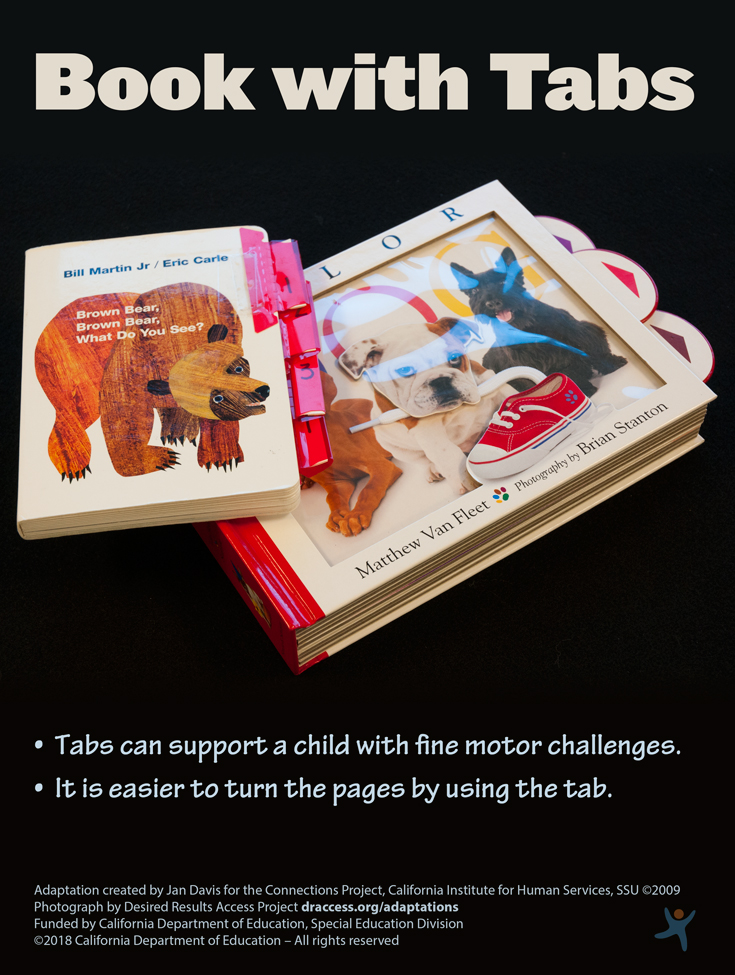 View a gallery of adaptations ideas that can be used with children with Individualized Family Service Plans (IFSPs) and Individualized Education Programs (IEPs) in daily activities, routines, and transitions.
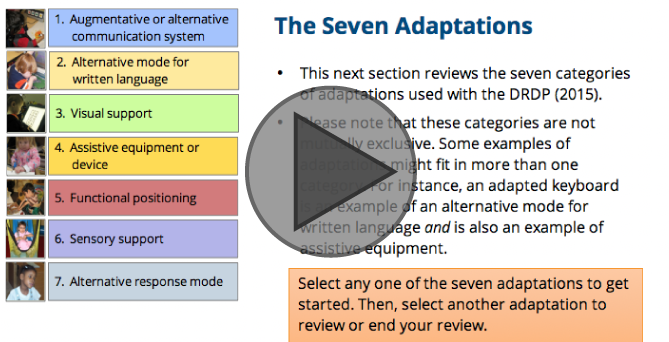 This interactive tutorial describes what adaptations are, how they can help us more accurately assess children’s skills as we observe their daily activities, and provides a variety of examples of the seven adaptations used for the DRDP.


